
When people are given the chance to learn and grow, they thrive. By adopting a coaching mindset, managers help their teams realize their potential, and research consistently links coaching to better engagement, higher productivity, better customer service and employees who overcome challenges and build confidence. The problem is that coaching is made of conversations, and most managers never get to practice them.
Coaching over managing
To become a leader, a manager must learn to coach. Command and control is long gone as a standard way of managing people, and coaching is today's most effective way to lead. Ed Batista's definition fits: coaching is about connecting with people, inspiring them to do their best and helping them grow, while challenging them to find their own answers.
Field studies show the cost of a poor coaching orientation on motivation and productivity, and the benefit of two organizational habits: managers who use listening and communication to involve others, set clear expectations and know themselves; and employees who have regular conversations with their leaders about individual and organizational goals, receive constructive feedback in both directions, and see their leaders reflect on their own practice.
Coaching as a way of managing demands new approaches: collaborating instead of controlling, delegating more, talking less and listening more, asking more questions and giving fewer orders, giving specific feedback instead of judgments. Every one of them is a conversational skill, and research is equally clear that most managers underperform at developing their teams through authentic, empowering conversations.
Who benefits most
Fostering empowering conversations across the whole organization is the new goal of talent development, because leadership conversations are increasingly multi-directional and cross-functional. All managers should be trained to inspire and empower rather than to tell. First-time managers and middle managers stand out, though: they are the most exposed to the opportunity, and the fear, of coaching their people to higher performance, and they are the organization's best gateway for injecting a coaching culture through example, nudging and listening.
What practice changes
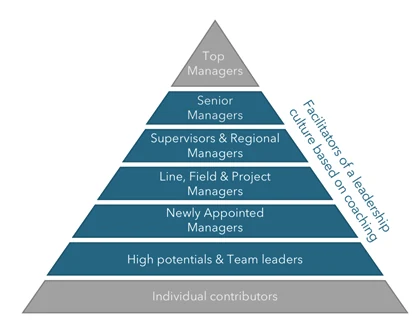
Practice is the most effective way to improve conversational skills and shift a manager's approach towards coaching. Confidence grows, self-awareness sharpens, the comfort zone expands with the first consistent steps. The shift in observable behavior that we see in managers who practice regularly looks like this: from answering questions to asking them; from describing excellence to modeling it; from evaluating results to observing behaviors and giving feedback on them; from coaching when necessary to coaching as a priority; from improvising to following a structure; from handing out action steps to guiding people through them; from feedback at review time to timely feedback in the flow of work; from treating obstacles as the issue to probing for the root cause; from outlining challenges to supporting people as they uncover their own.
The skills involved
Many skills take part in this shift. The twenty we see at its center include awareness of other people's needs, aiming for continuous improvement, confidence with the organizational context, diplomacy and tact, being inspiring, communicating efficiently, easing change, encouraging and valuing input, ensuring accountability, finding solutions, generating a positive mood, giving credit and recognition, giving immediate feedback when needed, having a clear vision of the problem, inspiring standards of performance, handling objections, removing obstacles, setting goals and long-term perspectives, sharing decisions, and tailoring approach and language.
Above them sit the two indicators that practice moves most: quality of the strategy, how well a leader uses the skills a coaching conversation requires, in context; and self-awareness, the accuracy with which they assess their own performance when it is over.
The conversations that matter most
Leaders face countless occasions for conversation. If I had to pick the four that most shift a team towards better performance through coaching:
- Negotiating an objective, using a coaching style to build the employee's confidence and appetite for bigger challenges.
- Delegating, so that the employee feels trusted and appreciated rather than offloaded.
- The priority-setting nudge, the gentle push everyone needs at some point, coached rather than ordered.
- Giving performance feedback, the key moment of the relationship, where coaching turns a limit into an opportunity.
How to deliver the practice
Supporting leaders in adopting a coaching style requires innovation in training design: practice on conversations has to be at the center of the journey, not at its end. Training on conversation means being an active part of a dialogue and receiving continuous feedback not only on communication skills but on self-awareness and self-efficacy.
Role play is the natural method, and classroom role play has limits: few repetitions, an audience, no review. Digital role play removes them. A manager practices a delegation or a feedback conversation with an AI character who has a personality and a standpoint, gets guidance from a live coach, hears how the character lived the conversation and reviews the whole exchange with an AI coach, as often as needed.
How much effort it takes
Having delivered thousands of practice programs to support the transition of managers to coaching, here is what the field says. A typical individual schedule takes one to one and a half hours a month, with one or two simulations every other week. On average, five to six months of regular practice are enough for 68% of trainees to improve their initial quality of the strategy by about 25% on the most common conversation types; within nine months, 92% reach the same result. We call it the efficient threshold: where people get the greatest benefit at the most sustainable level of participation.
Coaching cannot be learned from a definition. It is a set of conversations, and conversations are learned by having them.