
Reporting & Dashboard
Measurable skills development, without surveillance. Detailed results to the learner, program progress to the organization.
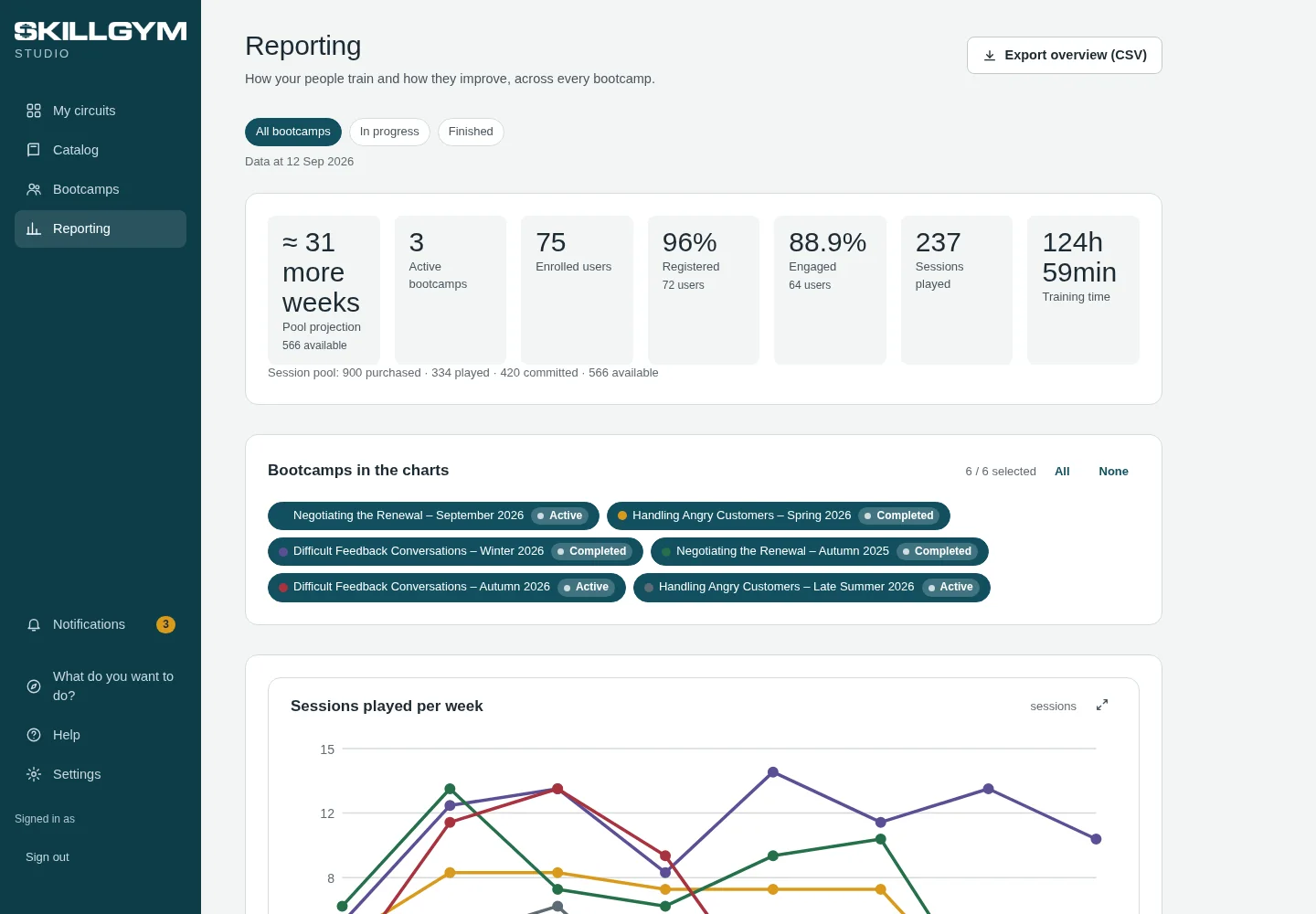
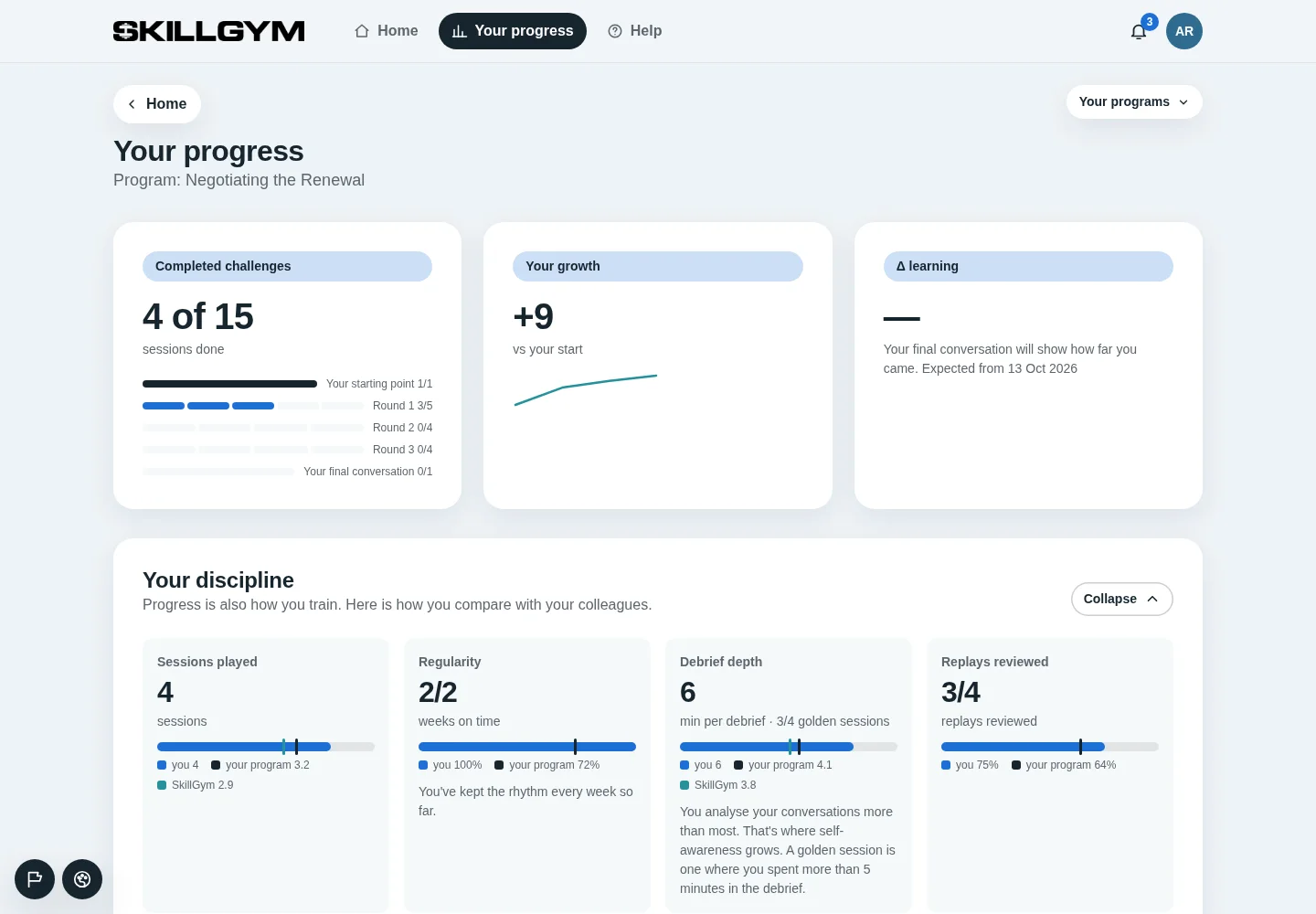
Who sees what
The trainee and the organization do not see the same thing, by design. Everything about a conversation stays in the trainee's private space. The organization sees the program, in aggregate.
The method behind the feature
Why it works
Self-awareness is the accuracy of your judgment about your own performance. 84% of professionals enter with low or intermediate self-awareness, across Skillgym programs.
Read why
Comparing self-assessment with the analysis of what was said makes the gap visible and gives the learner a concrete starting point for improvement.
From one session to a program view
- 1
Session
The trainee practices; what they said is analyzed against the scenario.
- 2
Learner feedback
Character account, Smart Debrief, coaching chat: in the learner's space.
- 3
Program view
Aggregates by team, bootcamp and period: in the program owner's dashboard.
What Skillgym measures
From what trainees say, by voice or text. Spoken words are transcribed and treated like typed ones.
Conversational strategy
How close each move is to your experts' approach.
Read more
How close each move is to the way your experts handle that moment, and how the strategy holds together across the conversation.
Impact on the character
How the character's attitude moved, turn by turn, as the scenario determines.
Read more
How the character's attitude moved, turn by turn, in response to what the trainee said, as the scenario determines it.
Self-awareness
Distance between self-assessment and evaluation.
Read more
The distance between the trainee's own assessment and the evaluation of the conversation, internal and external.
Knowledge and compliance
What was said, against your knowledge base and rules.
Read more
Whether what the trainee said was correct against your product knowledge base and consistent with your rules.
Behavioral competencies
50+ behaviors, aggregated on your model.
Read more
More than 50 behaviors, aggregated on your competency model, with improvement over time.
Program discipline
Participation, reliability, effort, balance: at program level.
Read more
Participation, reliability against the schedule, effort and balance of practice, followed at program level to steer the bootcamp.
Decisions a program owner can take from the data
Four examples of what aggregate data is for.
Adjust the rhythm
Reliability drops in week three: the protocol shortens the gap between sessions or changes the slot.
Add a scenario
One competency lags across a team: a scenario built on it enters the circuit.
Plan the workshop
The same objection trips most people: the next live session covers exactly that.
Report to sponsors
Participation and improvement trends, by team and over time, in a weekly report.
What reporting does not do
No individual dashboards for managers
Detailed results, debrief texts and coaching chats belong to the learner.
No ranking exposed to others
Peer comparison is anonymous and shown only to the learner.
No analysis beyond what was said
No voice, face, biometric or emotional data about the trainee.
No automated decisions
Reporting informs programs, never decisions about people.
Read the method
Three articles from the Skillgym blog, for those who want the full reasoning.
Eight Key Metrics for a Successful Practice Program on Critical Conversations
Four result metrics and four discipline metrics: the twenty percent of measures that explain eighty percent of what happens in a practice program.
5 min read
Making the Best of Skillgym Analytics
How to read the analytics of a Skillgym conversation: quality of the strategy, self-awareness, objectives, phases and competencies, and how they relate to each other.
5 min read
Self-Awareness: The Single Factor That Most Influences the Speed of Leadership Development
How Skillgym measures self-awareness in a conversation, why performance accelerates only after a threshold, and where most leaders start.
4 min read