
Competency Mapping
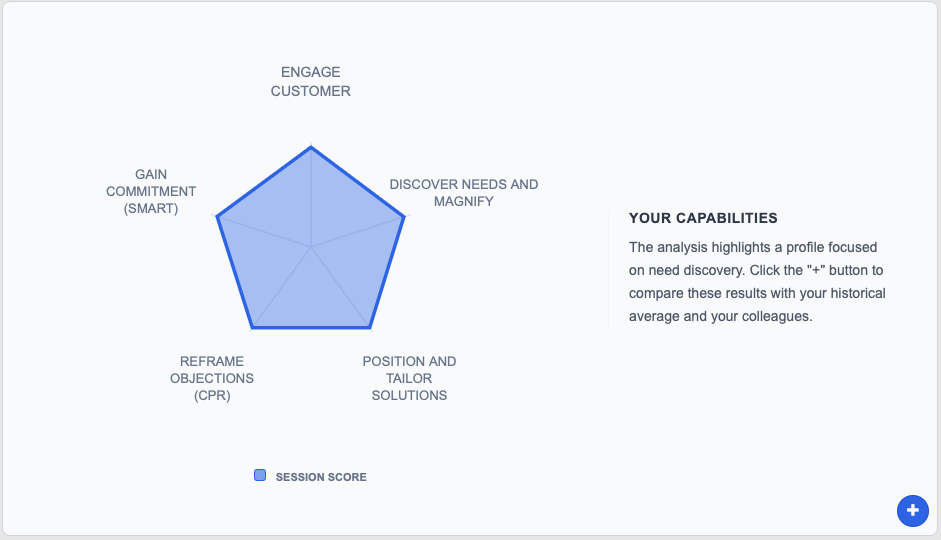
Your model is the benchmark. 50+ behaviors measured from what trainees say, mapped on your framework.
Your model is the benchmark
Skillgym does not define the competencies people are measured against. You do. Your framework enters the scenario at authoring time and becomes the yardstick for every conversation. The grading is situational: the same open question is optimal when exploring and wrong when summarizing, so each behavior is graded for who the character is, what the conversation is for and where in the conversation it happens.
The method behind the feature
Why it works
Observable behaviors are the level at which a competency model becomes trainable and measurable.
Read why
Each behavior is graded for its context: who the character is, what the conversation is for and when it occurs. That turns an abstract framework into criteria that can be applied to what was said.
From behavior to competency
A hierarchy that makes an abstract model concrete in people's own sentences.
Observable behavior
A recognizable action in what was said, graded for that context.
Read more
The only level that can be observed and changed directly. Graded on up to five levels, from optimal to weak, with six criteria: character, type of conversation, topic, scope, seniority of the trainee, moment in the conversation.
Skill
Behaviors aggregate into skills, checked many times across a circuit.
Read more
Each skill is checked around ten times along a circuit, so the measure is weighted and stable; a single ambiguous sentence cannot move it much.
Competency
Skills aggregate into your competencies, with your structure and weights.
Read more
Ready-made scenarios are remapped onto your model by analyzing the meaning of each skill; custom circuits are built on your model from the start.
Knowledge & compliance
Checked alongside behaviors, against your materials.
Read more
So the trainee sees where the approach was right and the content was not, or the other way round.
Example: one sentence, four levels
An anonymized illustration of how a sentence travels up the model.
- What the trainee said
- "Before I go into our offer, can you walk me through how your team handles this today?"
- Behavior recognized
- Asks an open exploratory question before proposing. Graded optimal: it is the discovery phase, the character is a skeptical buyer, and nothing has been pitched yet.
- Skill
- Asking questions (one of the skills under Active Listening).
- Competency
- Customer Focus, in the client's framework, with the weight the client assigned.
- Feedback
- The character: "I appreciated that you asked before telling." The debrief: the question opened the conversation; the follow-up two turns later closed it too early.
Bringing your framework in
Import
Your competencies, behaviors and anchor descriptions, in any format you have.
Map
We align the behaviors measured in conversations to your model, with you.
Validate
You approve the mapping before the first session. Changes are versioned.
Not inferred
Nothing beyond what was said: no traits, no states, no predictions about the person.
Completion recognition, not certification of performance
Badges and attestations for completing a bootcamp or reaching participation targets recognize the practice done. Skillgym does not certify individual readiness or performance, and no decision about people is automated. See AI Ethics and Reporting & Dashboard for who sees what.
50+
behaviors measured from what trainees say
5
levels of grading, in context
Read the method
Three articles from the Skillgym blog, for those who want the full reasoning.
Making a Competency Model Truly Actionable in People Development
Domains, competencies, skills and observable behaviors: how to clarify a competency model and connect it to practice that can be measured against it.
6 min read
The Backbone of Digital Role Plays: How a Simulation Is Designed
Behind every effective digital role play there is a design process: four pillars, a leadership style, observable behaviors and a plot. Here is how it works.
5 min read
Map practice to your competency model
Bring your framework to the demo and see a conversation measured against it.