
Human-in-Command
Humans design the method, validate the content and use the results. The AI makes the conversation real; it decides nothing about people.
Humans design
Scenarios, grids and criteria are written and validated by people.
Read more
Scenarios, competency grids, feedback criteria and coaching strategies are written and validated by people: your experts and our content team. The AI executes what was designed; it does not invent the yardstick.
Humans decide
No automated decision about anyone. Individual results belong to the learner.
Read more
Skillgym makes no judgment about people. It does not select, promote or certify anyone, and produces no prediction about a person's future behavior. In the training configuration, individual results belong to the learner and the organization follows the program. Where a client uses Skillgym within its own assessment process, results go to the assessors the client designates, with the evidence behind every score, and the decision stays with them.
Only what you say
The only input is what the trainee says, by voice or text.
Read more
Spoken words are transcribed and from that point treated exactly like typed ones. A session played in text produces the same outputs as the same words spoken.
No voice analysis
From audio, only the words. No tone, pitch, rhythm or pauses.
Read more
No tone, pitch, volume, rhythm, pauses, hesitations or speaking speed are extracted or used. The transcription service returns text only.
No camera
The trainee's camera is never on. No face, posture or gesture.
Read more
The trainee's camera is never activated. No facial expressions, posture, gestures or gaze are observed.
No inference
No emotion, mood or personality trait of the trainee is inferred.
Read more
No biometric or physiological data is processed, and no emotion, mood, personality trait or psychological state of the trainee is inferred.
Non-self-learning
The system does not learn from sessions. Changes are human, versioned releases.
Read more
The system does not learn from sessions and does not change its criteria on its own. Every change to a scenario, a grid or a weight is a human decision, validated and released as a new version, so everyone is measured the same way, today and in a year.
No training on your data
Enterprise APIs with no-training clauses. Nothing leaves your environment to teach a model.
Read more
Models are used through enterprise APIs with contractual no-training clauses. Client data is never used to train models, ours or anyone else's.
The method behind the feature
Why it works
Governance is not only a compliance choice. General-purpose models can become more agreeable as a conversation develops.
Read why
Fixed, human-validated criteria preserve constructive disagreement and keep measurement comparable over time. The same governance layer that protects people also keeps the practice useful for learning.
Character emotional feedback, explained
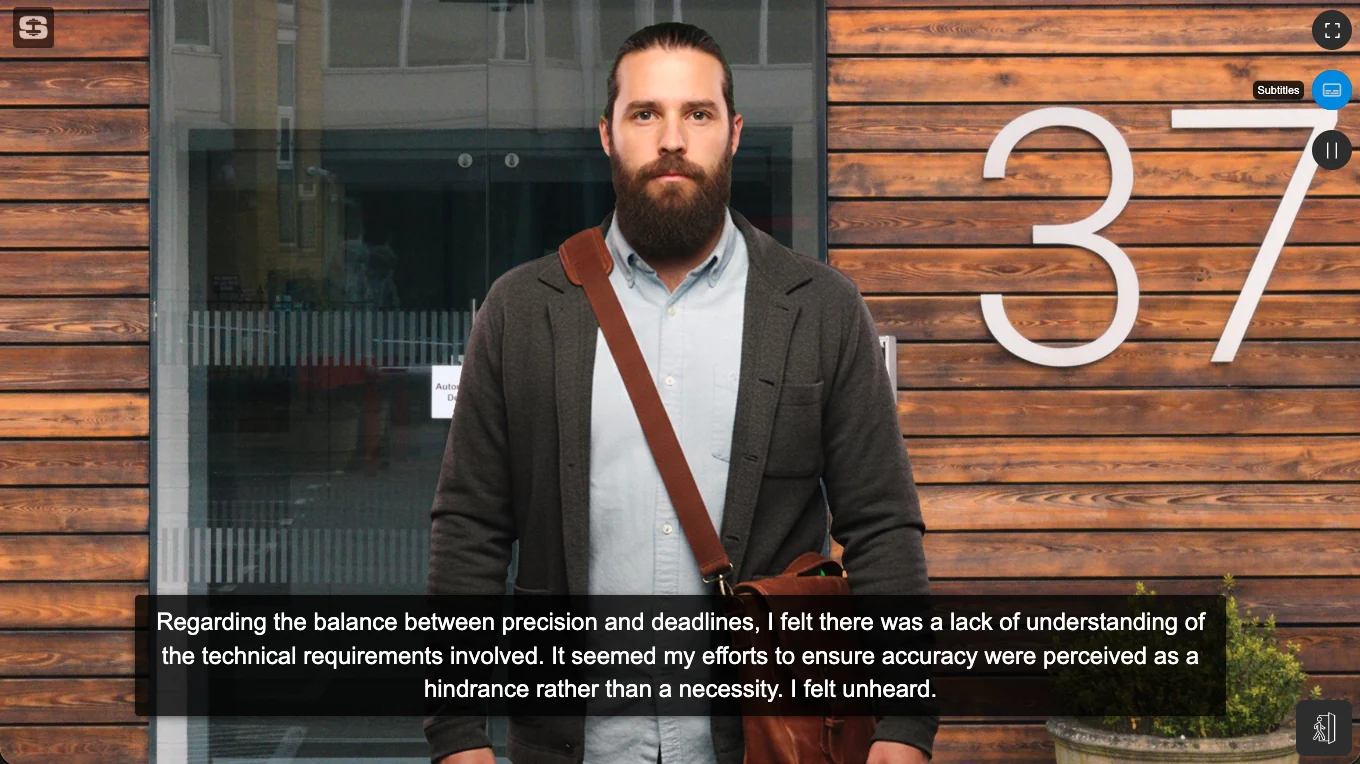
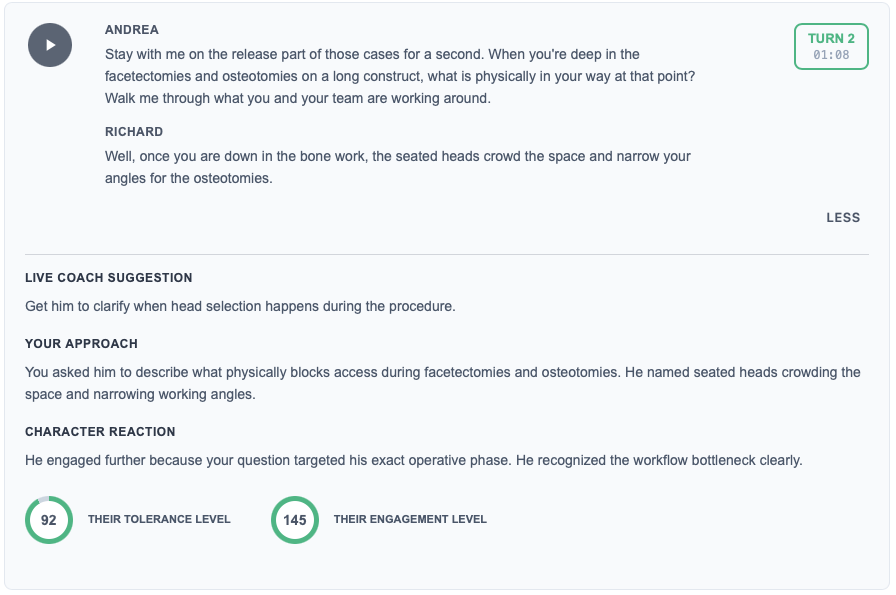
After a conversation the character says how they lived it: "I felt heard when you asked what I thought; when you said the decision was already made, I shut down." It is the character's emotion, not the trainee's. The character is a fictional entity whose attitude changes according to the strategies recognized in what the trainee says, following rules written by the designers. The scenario decides it; the system never reads the person. The same is true of the note over the character's video that explains their reactions moment by moment.
See also
- Security Compliance
Hosting, isolation, encryption, access.
- Data Privacy Compliance
What data, where, for how long, who can ask for what.
- Reporting & Dashboard
Who sees what, and what reporting does not do.
- Our Commitments
Seven verifiable promises on responsible AI.
Read the method
From the Skillgym blog, for those who want the full reasoning.
How AI Delivers an Authentic Training Experience in Skillgym
Why branching was never the answer, the three forces that shape a real conversation, and how governed AI reproduces them in a character who stays themselves.
5 min read
Why Stimulate Self-Awareness by Using Both Sides of Your Brain
Self-awareness grows fastest when emotional feedback and objective metrics arrive together. How self-assessment, the character's account and analytics combine.
4 min read
Discuss your AI governance requirements
We answer AI compliance committees in detail. Bring the questions.