
AI Role Play
Realistic conversations with characters who hold their ground. Governed AI, so the practice stays real and the measurement stays fair.
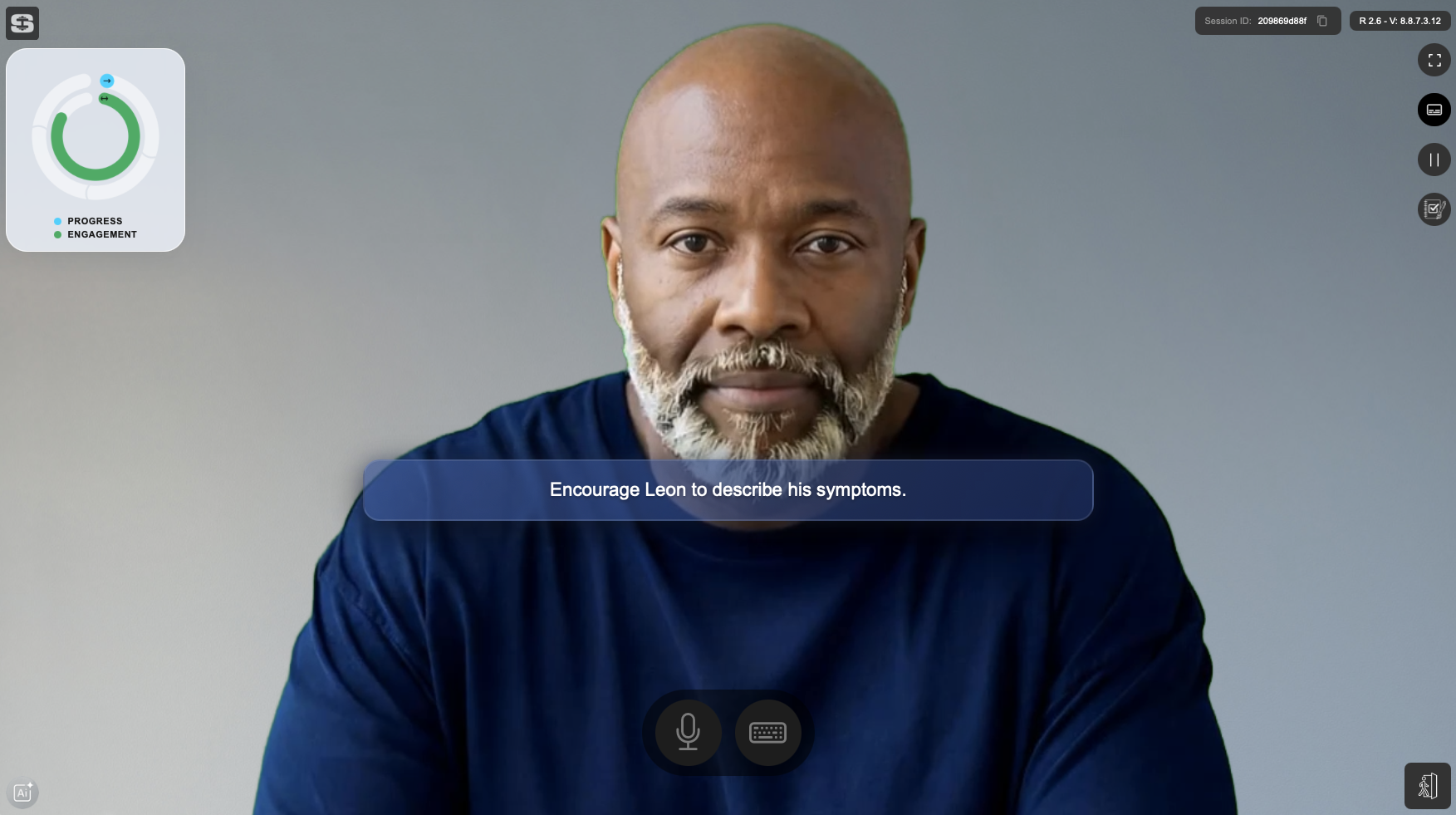
One session, four steps
- 1
Prepare
Context, character and objectives, organized the way an expert reads the situation.
Read more
Before the conversation, the trainee enters a preparation room. It does not give a generic briefing: it organizes the information along the expert's model, the variables to watch, the signals to read, the strategy to keep in mind. The trainee starts the conversation already looking at the right things.
- 2
Practice
A free conversation, by voice or text, with an AI Live Coach suggesting the next move.
Read more
The trainee talks with a real-time digital human who has a defined personality, situational needs and a standpoint, and keeps them for the whole conversation. The coach's hints adapt to the trainee's level: fully guided for beginners, pure strategy for experienced people. Multiple valid paths lead to the same objective.
- 3
Feedback
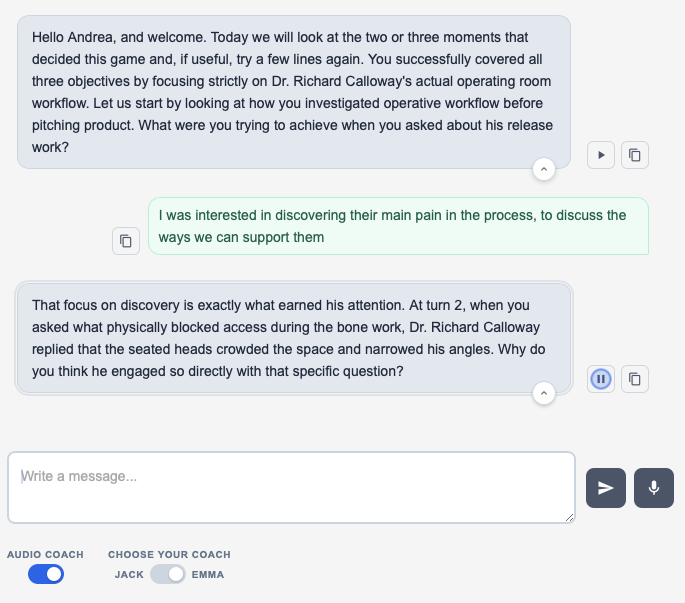
The character's own account, then a Smart Debrief with 20+ metrics and a coach to talk it through.
Read more
Trainees assess themselves first. Then the character tells them, in first person, how they lived the conversation; a note over the character's video explains what they were feeling at each moment. Then the Smart Debrief: metrics, turn-by-turn commentary, pointers on product-knowledge and compliance gaps, and an AI coach informed on that exact session who can replay the critical moment.
- 4
Progress
Your results, your evidence, your trend over time. Yours alone.
Read more
Each trainee's conversations, recordings, debriefs and coaching chats live in a private space. The organization sees the program, not the individual's debrief.
The method behind the feature
Why it works
A general-purpose model can produce an agreeable conversation that feels useful without challenging established behavior.
Read why
Skillgym's governance layer preserves the character's standpoint and the structured disagreement a learner needs. What the learner's memory stores is real experience, and real experience is what comes back under pressure.
Governed by design
This is not free AI chat. 120+ proprietary algorithms sit above the models.
Strategy, not words
Every move is read for what the trainee was trying to achieve, not matched to a script.
Read more
A generative model on its own tends to agree with the user and loses the thread over a long conversation. In Skillgym an agent recognizes the strategy expressed in each sentence and compares it with how your experts handle that moment; the character reacts to that, not to the words.
Consistent characters
Personality, needs and standpoint are set before the conversation and held throughout.
Read more
A second agent governs the character's consistency, so a skeptical character does not become agreeable because the trainee insists, and opens up only to moves that deserve it.
Your rules inside
Product knowledge and compliance guidelines are part of the scenario.
Read more
What the trainee says is checked against your materials and your rules, and the gaps are reported back to the trainee in the debrief.
Guard-rails
Every output is checked against the scenario before it reaches the trainee.
Read more
Agents verify generated text for coherence with the scenario and the character, so the simulation does not take unexpected turns.
Isolated data
One environment per client. No client data trains any model.
Read more
Each client has dedicated, isolated database instances; models are used through enterprise APIs with contractual no-training clauses.
Non-self-learning
Criteria change only by human decision, released as a new version.
Read more
The system does not learn from sessions. Everyone is measured with the same criteria today and in a year; every change is validated and versioned.
Feedback from three angles
Trainees assess themselves first. Then the character tells them how they lived the conversation, in their own words: the scenario decides the character's reactions, and the system never analyzes the trainee's emotions. Then the Smart Debrief: metrics, turn-by-turn commentary, knowledge and compliance pointers, and a coach who knows that exact session.
120+
proprietary algorithms govern the models
0.88 F1
AI classification accuracy when guided by a rigorous definition (Springer Nature, ICCCI 2026)
Read the method
Three articles from the Skillgym blog, for those who want the full reasoning.
How AI Delivers an Authentic Training Experience in Skillgym
Why branching was never the answer, the three forces that shape a real conversation, and how governed AI reproduces them in a character who stays themselves.
5 min read
Building Authentic Characters for Effective Digital Role Plays
The psychometric models behind Skillgym characters, and why a character with a personality, needs and a standpoint is what makes a role play worth playing.
5 min read
Digital Role Play Stripped Bare: What It Is and How It Works
What a digital role play actually is, what the word digital adds to a classic role play, and the seven components that make one work.
6 min read
See a conversation in action
Have a conversation with one of our characters, and read the feedback it produces.