
Learning Methodology
Accelerated Expertise Training: a Neuroscience-based method for skill acquisition, developed since 2012, with six million practice sessions played on the platform since then, anonymized and aggregated.
Behavioral change. Engineered
Four stages, from your experts' know-how to a habit.
- 1
Capture
Your experts' mental model becomes the blueprint of a circuit.
Read more
Experts cannot explain how they do what they do; their patterns live in procedural memory. Our authoring pipeline surfaces the critical cases, the moments of choice and the signals they have learned to read, and turns them into a map: strategies, variables, thresholds. That map is the blueprint of the scenarios.
- 2
Play
Guided practice from the first session, with multiple valid paths.
Read more
The AI Live Coach guides towards the expert's strategy while the conversation happens; the character reacts to the strategy expressed in what the trainee says. Guided, not scripted: there are many good ways to reach the objective, and the trainee finds their own.
- 3
Learn
Self-assessment, the character's account, Smart Debrief and coaching.
Read more
Feedback is designed to get past cognitive shields: first the trainee's own judgment, then the character's emotionally charged account, then the analysis and a coaching chat that connects each choice to its effect.
- 4
Practice
A protocol sets rhythm, repetition and difficulty, in bootcamps of 4 to 8 weeks.
Read more
Velocity is built in depth, repeating a few scenarios with growing difficulty until the response is automatic. Flexibility is built in breadth, across varied scenarios, until the skill transfers to situations never seen before.
The Practice Fastlane
The difference is in kind, not in degree: a different process, not simply more or faster sessions.
Role play alone
Scenarios are chosen one by one, with no designed progression between them. Transfer to new situations is left to chance.
The Practice Fastlane
Connected scenarios develop the same competencies in different situations, so flexibility is built on purpose.
Role play alone
The learner brings the behaviors they already have and improves by trial and error.
The Practice Fastlane
The Live Coach guides the learner towards the expert's strategy from the first session. Many valid paths, one direction: guided, not scripted.
Role play alone
A completion metric or absolute score shows the outcome, but not what caused it or what to change.
The Practice Fastlane
Self-assessment, the character's account, a Smart Debrief with 20+ behavioral metrics in context, and a coaching chat reveal cause and effect.
Role play alone
Without a protocol, frequency, sequence and progression depend on each learner.
The Practice Fastlane
A protocol defined by our method team sets how many sessions, how often and in what sequence, to build velocity and flexibility measurably.
Practice left to the learner can progress slowly and unevenly. Practice designed around our protocol and focused on your expert's mental model creates a guided, measurable progression.
What a bootcamp looks like
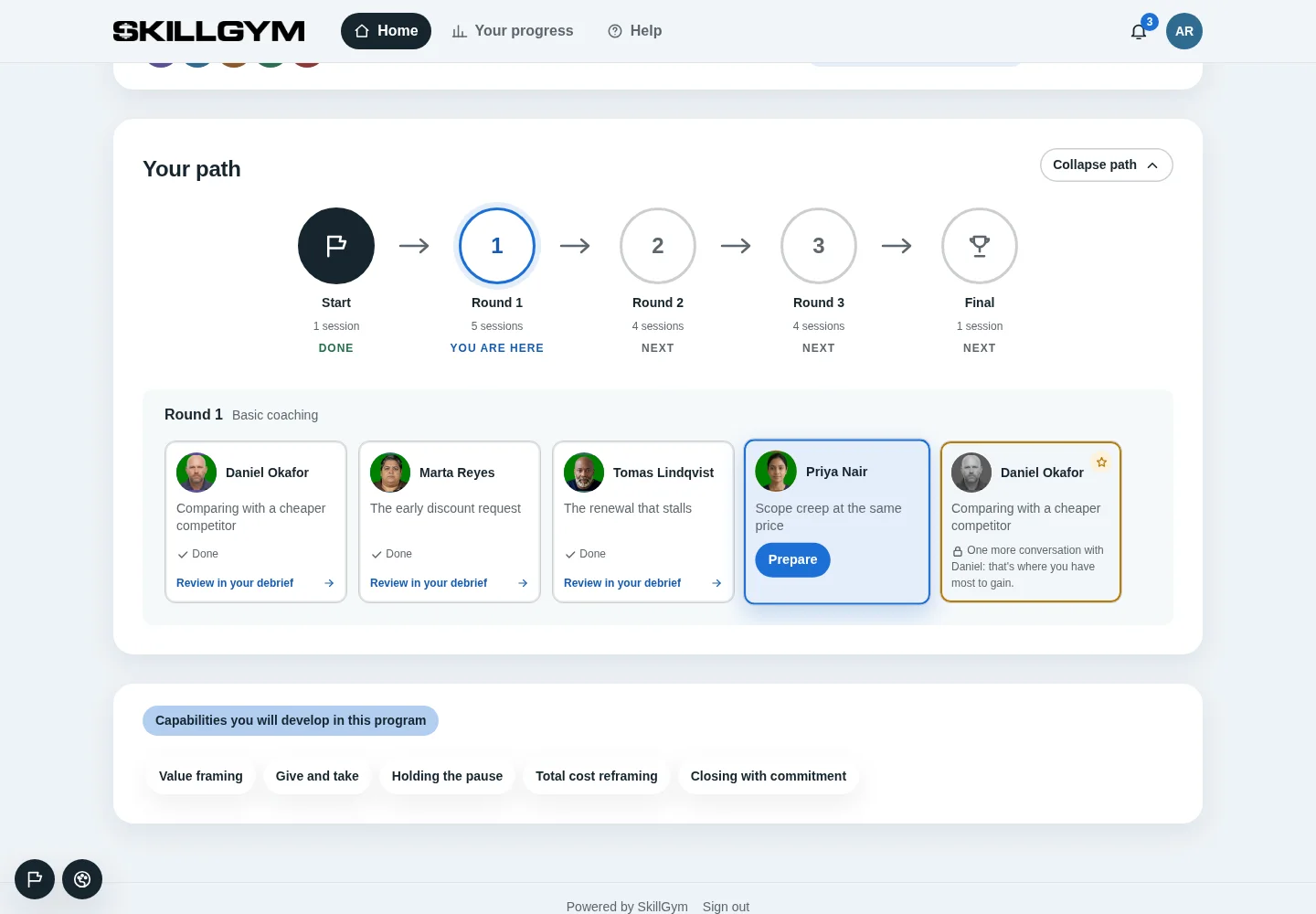
A program built for your people, organized around a handful of conversations and a set rhythm: the most direct way to prepare and stay fit for everyday challenges.
- Population
- A cohort of new sales hires.
- Conversations
- Four scenarios in a circuit: the discovery call with a skeptical buyer, the price objection, the stalled negotiation, the renewal at risk. Two levels of difficulty each.
- Rhythm
- Six weeks, twelve 20-minute sessions per person, one or two a week, sequence set by the protocol.
- What the learner gets
- Live Coach in session; self-assessment, the character's account, Smart Debrief and coaching chat after it; their own trend over the six weeks.
- What the program owner gets
- Participation and reliability, improvement trends by cohort, where the selling model is holding up. Not individual debriefs.
Illustrative program structure, not a specific client case.
Why practice, not information
Experts don't think more; they think differently. They recognize a pattern and act. Non-experts hold simplified mental models that resist information and work as cognitive shields. Skills in ill-structured domains such as communication, negotiation and leadership transfer only when practiced across varied, realistic cases; a faulty model changes only when put under pressure by direct experience. That is the research behind every circuit, and it is why 84% of professionals entering a program with low or intermediate self-awareness is where the work has to start.
Evidence behind the method
- 6M
- practice sessions played on the platform since 2012, anonymized and aggregated
- 500K+
- professionals
- 20 min
- typical session
- 4–8 weeks
- bootcamp
+8.5 vs +3
points of median improvement, practice group vs control group (USI Lugano)
84%
of professionals enter with low or intermediate self-awareness across Skillgym programs
AI Role Play alone doesn't change behaviors. Disciplined practice does.
Read the method
Three articles from the Skillgym blog, for those who want the full reasoning.
The Neuroscience Behind Skillgym Practice
Encoding and retrieval, automaticity, familiarity and self-awareness: how practicing critical conversations changes the way the brain performs them.
5 min read
The Learning Theories Behind the Skillgym Method
Adult learning is different. Andragogy, experiential learning, simulation, flow and feedback: the theories that shape how a Skillgym session is designed.
5 min read
Our Brain Doesn't Tell the Difference Between Simulation and Reality
Why simulation works for training: the brain learns by replicating what it does, and a realistic simulation is processed as if it were real.
5 min read
Build a disciplined practice program
See what a disciplined practice program looks like for your organization.