
Adjusting a training program while it runs is one of the most discussed topics in L&D. Adaptive learning means using data to modify content, schedule and difficulty for each learner according to their results and, I would add, their discipline. Research shows positive effects of many approaches, and is still looking for the common traits of a well-balanced one. Here is how we approached it.
Why schedules need to be personal
We had long noticed that the closer a program fit the real needs of trainees, the higher the engagement, the satisfaction and the improvement on the metrics that matter. Finding and maintaining that fit for every person, by hand, was impossible for any L&D team at scale. So we built a structured way to manage the continuous adjustments a good program requires, starting from two convictions.
For conversational training, the schedule has to feel tailor-made, and not only in content: in pace. Acquiring new behaviors takes consistent work, and nothing is worse than a program set by someone else that never fits your agenda.
And mastery of conversation is not a learning activity with an end. It is a fitness condition. The more you practice, the better you perform; the less you practice, the faster you fall back into old habits. The sports metaphor is exact, and that is why we called this part of the method Digital Fitness.
Start with what people say they need
When a trainee enters a program, the first step is listening: a short questionnaire, under ten minutes, on how much effort they can sustain, which time slots suit them, which types of conversations they find most critical, and how they prefer to be reminded. The protocol takes these preferences at face value and builds the first schedule on them.
Adjust along the way
Reality quickly differs from what people declare on their first day at the gym. Trainees are busier than they think, and postpone or skip sessions. Real habits emerge: most people end up practicing on the same days and often at the same times. And many over- or underestimate their needs, performing well on conversations they feared and poorly on ones they felt comfortable with. Self-awareness, again.
The protocol follows two things, when the trainee actually attends and how they perform in the different conversations, and adjusts the schedule accordingly: dates, frequency and types of conversation. Declared preferences are overwritten by evidence of real availability and real needs. Adjustments happen weekly or monthly depending on pace, and a history is kept so that a trainee entering a new program starts from a better-fitting plan on day one. Typically, a few weeks to a few months of sessions are enough for the protocol to settle on a schedule that fits.
Two points deserve precision. The adjustments follow rules set in the protocol and applied to attendance and results; the system does not learn or change its criteria on its own, and every change to the rules is a human decision. And the data it uses is the trainee's own practice history: when they showed up, what they said and how it was evaluated. Nothing else.
What the protocol adjusts
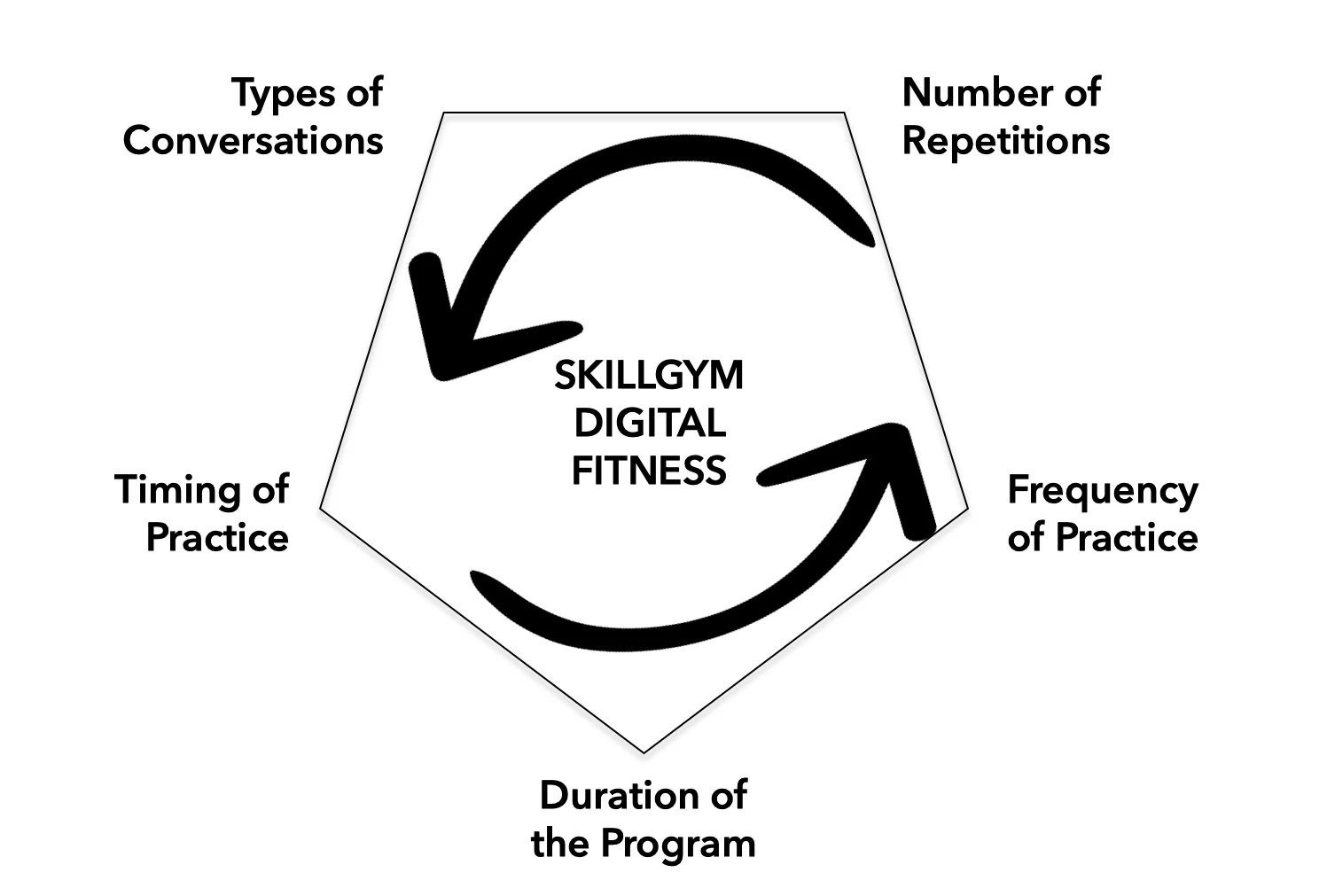
Depending on the evidence, the protocol can change the overall duration of a program, the frequency of sessions, their timing, the number and spacing of repetitions of a given conversation, and the mix of conversations, characters and subjects, following the evolution of confidence and the other metrics. The result is a far more personal path towards mastery.
The impact
Since introducing adaptive scheduling we have followed its effects from several angles.
Engagement. Personalized, adaptive paths achieve on average 25% to 37% higher reliability, the share of scheduled sessions actually attended.
Pedagogical fit. There is almost always a gap between declared needs and actual performance, usually in the direction of overestimating comfortable conversations and underestimating uncomfortable ones. On average, the frequency and mix of an initial schedule shift by 25% to 30% as the program runs. That is not a failure of the trainee's prediction; it is the point of adapting.
Sentiment. 85% of trainees report a better fit of the schedule, both with their agenda and with their evolving needs.
Results. Comparing manually set programs with adaptive ones over the same period and comparable effort, trainees on adaptive programs improved about 25% more on all the metrics considered. Adjusting pace and mix makes a large difference.
Less work for L&D. The system does this on its own. Trainers can still take control of assignments, and in practice nobody does, because the protocol keeps the effort-result balance within range and the manual equivalent is unsustainable.
Return. Combining the effort saved by L&D, what trainees report about the program, the extra results and the efficiency of practice time, the projection is clearly positive.
Where this sits today
What began as Digital Fitness is now one of the layers of the Skillgym architecture: the training protocol that governs a person's path through a circuit, configuring their rhythm, adapting between scenarios, measuring cross-scenario progress and keeping engagement alive. The principle has not changed. Conversational skills are kept fit, not learned once, and the program that keeps them fit has to fit the person.