
Digital role plays are powerful tools for developing the way people handle critical conversations. As they become part of trainers' and trainees' daily life, their design becomes the thing that separates a useful tool from an expensive one. This article walks through the process behind a Skillgym scenario, from the first decisions to the plot.
Four pillars before the first line
Before anyone writes a scenario, four pillars define its core: the purpose of the conversation, the topic, the user's role and the character.
Purpose. What is this conversation for? In leadership, we work with four big families of critical conversations: Inspire, Lead, Support and Discover. A leader can try to inspire the team around a vision, lead someone to make things happen, support a team member in their daily work, or discover needs and facts to make better decisions.
Topic. The purpose defines the macro area; the topic makes it concrete: teamwork, performance, strategy, diversity, priorities. Topics can be ordered along several axes (subjective or objective, review or plan) and each one changes how the conversation should be handled.
The user's role. Who is practicing? A sales manager, a project leader, an HR business partner; junior or senior; front line or back office. The same situation is designed differently for different targets.
The character. Not only their role in the team, but their personality, their way of seeing things, their reactions and their needs. We build characters on recognized models such as DISC, HBDI and Maslow's hierarchy of needs, so that a Dynamic character, action-oriented and focused on results, behaves differently from a Diplomat, tactful and empathetic but reluctant to leave their comfort zone.
Put the four together and you have a situation. For example: a junior back-office leader who needs to support a Diplomat, reluctant to change, on a performance issue. Or a senior front-line leader who needs to inspire two skeptical team members on a strategy topic.
One situation, one style
Once the situation is defined, the question becomes how to handle it well. Just as you adapt your words to the person in front of you, you adapt your leadership style to the context. You do not use the same approach to give negative feedback, to help someone set priorities, to align the team on a new strategy or to explore a diversity issue.
Our scenarios draw on six styles, in the tradition that runs from Kurt Lewin to Daniel Goleman: Commanding, Visionary, Affiliative, Coaching, Pacesetting and Democratic. Aligning the team on strategy calls for the Visionary style; a diversity issue for the Affiliative one; setting priorities together for the Democratic one. The choice of style is a design decision, and it determines everything that follows.
From skills to observable behaviors
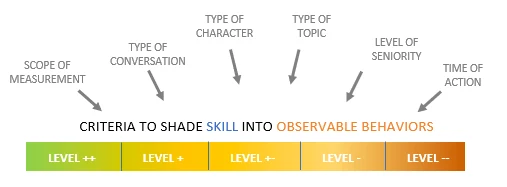
The next step is defining the actionable skills the scenario trains. A leader's skills are visible in observable behaviors: communication skills break down into "ask questions", "provide information", "find common ground"; motivation skills into "be inspiring" or "give credit".
Which behaviors matter depends on the style chosen for the situation: "be authoritative", "communicate efficiently" and "remove obstacles" in a Commanding style; "be inspiring", "read the other person" and "generate a positive mood" in an Affiliative one.
Each skill also has a shading: the range from the best possible way of using it to the worst. And the shading varies with five factors:
- the character, because the same skill works differently with different personalities;
- the user's role, because what counts as good for a junior may be insufficient for a senior;
- the type of conversation, because inspiring and supporting call for different uses of the same skill;
- the topic, because giving feedback and setting priorities are not the same meeting;
- the moment in the conversation, because open questions are the right move when exploring needs and closed questions are the right move when summarizing them.
This is what turns a competency model into something a scenario can measure: not the name of a competency, but the behaviors that express it, graded in context.
Adding the plot
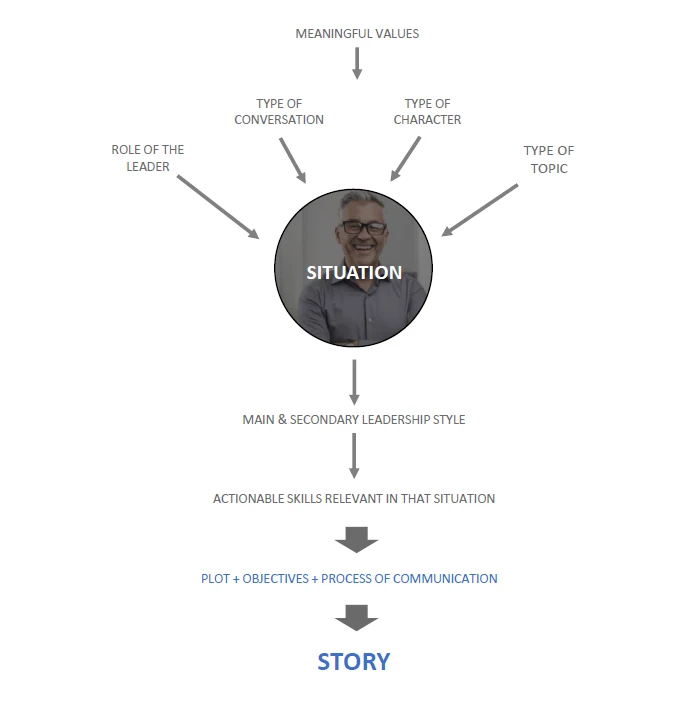
With the situation, the style and the behaviors defined, the plot can be written: the problem the leader is facing, the character in detail (name, age, background, situational needs, how they talk), who asked for the meeting, where and when it takes place, and the context around it.
This is also where the expected outcomes are set: the objectives the leader has to reach, such as defining the character's problem, rebuilding their confidence or making them aware of a critical situation. The communication strategy is built around these objectives as a sequence of steps, for example analyzing the problem, sharing a workable solution, agreeing the next milestones. The story is the last thing that gets written, and it rests on everything before it.
From design to experience
A process this structured is what allows the finished role play to give the trainee two kinds of feedback: the character's own account of how they lived the conversation, and objective metrics on behavior and outcome. Using both engages the analytical and the holistic side of the brain, which our experience shows is the fastest route to self-awareness.
What has changed since the branching days
The pillars, styles and behaviors described here have not changed. What has changed is how the plot is produced and played. Today the same design logic is executed by agents that read the client's own materials, interviews with top performers, playbooks, recordings, and turn them into a circuit of scenarios built on the client's competency model and terminology. And the trainee no longer picks from options: they speak freely, and the character reacts to the strategy expressed in what they say.
The story remains the tip of the iceberg. Who, what, when, where and why still have to be decided first. That is what makes the conversation feel real, and what makes the measurement mean something.