
When we started designing conversational simulations, we were obsessed with one thing: realism. The market at the time answered the demand for interactive training with branched solutions, where every choice led to one predetermined reaction. Serious games were appearing, with avatars walking the user through short, predictable stories. Better than reading documentation, but still too basic. In real life we do not interact like that: every decision and every emotion is the result of many factors merging, and the nuances of behavior are almost unlimited.
Even today, the first question people ask when they see Skillgym is "what kind of branching did you design?" The answer is none, and this article explains why and what we do instead.
Why branching fails
Branching is black-or-white. It is good for teaching concepts and useless for experiencing the complexity of a conversation, where internal perceptions and external circumstances continually shape what both people say and mean. Consider a few situations.
You say the wrong thing to a colleague. It happens. A branched simulation lets you pick a better option next, and the character moves on as if nothing happened. In real life your colleague is still unhappy with what you said before, and that colors everything that follows.
The character reacts to one of your sentences with a subtle shift in attitude. In real life, your next sentence lands on that shift. In a branched simulation, the nuance was never designed in.
You play the simulation again, as you should, since it is training. You say the same thing you said last time, in slightly different circumstances. In a branched simulation, exactly the same thing happens. In real life, almost never.
Life is not branched, even if we try every day to reduce it to left-or-right turns.
The three forces that shape a conversation
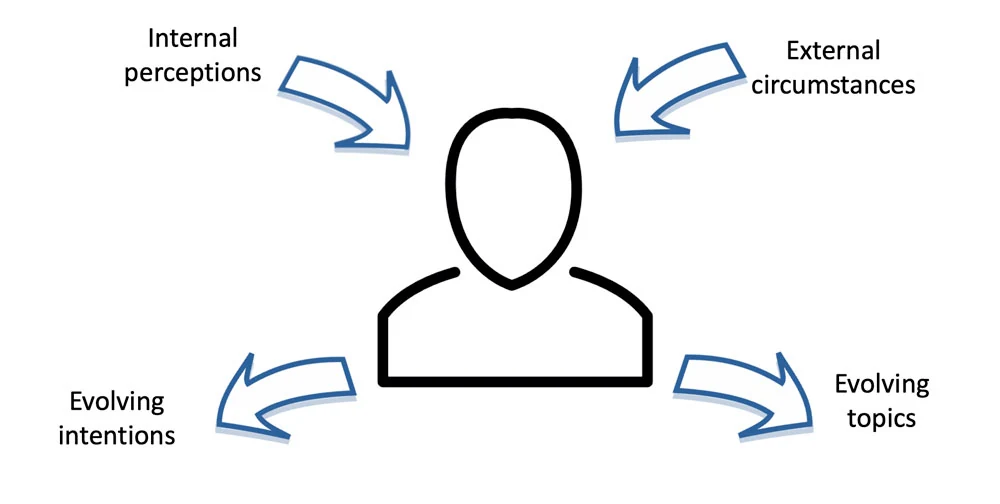
Reproducing a real conversation means handling three forces at once.
The flow of the conversation influences the character. Every step is linked to the previous ones and shapes the next. The character's reaction, in words and in attitude, depends on what happened to them before the conversation started, on how it has gone so far, and on what they now expect. A conversation that starts badly, for reasons outside your control, is harder to manage than one that starts with a relaxed counterpart, and the deeper you go, the more each reaction is colored by the perception the character has built of you.
The profile of the character determines their reactions. How this person processes information, how they show or hide what they feel, how they handle pressure. Our characters are built on recognized psychometric models, and each one reacts in their own way to the same move.
The user's approach influences the interaction. The trainee is an active part: the style they adopt, the coherence of their behaviors, their attention to the weak signals the character sends. A style that seemed to work can become wrong as the context evolves, and noticing it in time makes the difference between going north or south.
Enter governed AI
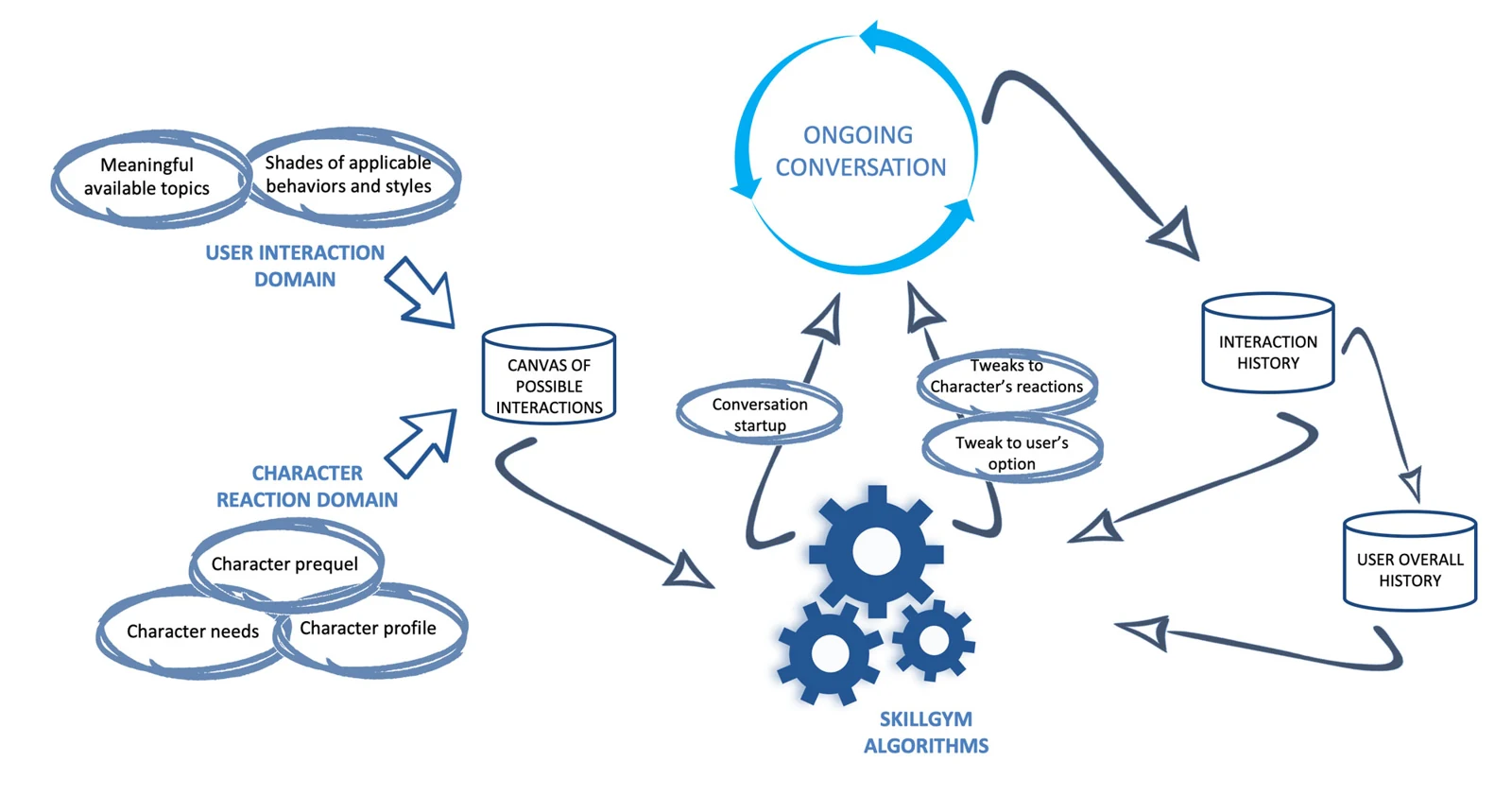
Handling these three forces in real time requires technology, and this is where the architecture of Skillgym matters. The trainee speaks freely, by voice or by text. The character answers in natural language. And in parallel, invisible to the trainee, a system of specialized agents does three jobs at once.
One agent recognizes the strategy expressed in what the trainee just said: not the words, but what the sentence is trying to achieve in the conversation, and how close that is to how an expert would handle the moment. A second agent governs the character's consistency: their personality, situational needs and standpoint are fixed before the conversation and held for its whole duration, so the character does not bend to please, and opens up only to moves that deserve it. A third agent decides how the live coach should help the trainee adjust at the next turn, based on what has actually happened in this conversation rather than on an ideal script.
There are no decision trees and no predetermined paths. The agents compare the course of the conversation with the expert's model and with who the character is. That comparison drives how the character responds, how the trainee's choices are evaluated and what the coach suggests next.
Why this needs governance, not just a model
A generative model on its own tends to be agreeable: it was trained to please, and under pressure it drifts towards the user's expectations. For training, that is a disaster, because the trainee practices in a comfort bubble and meets real resistance only at work. Governance is what prevents it: the character keeps structured disagreement, calibrated on their profile, and holds their position for the whole conversation.
Two more properties follow from the design. The system knows what the character is feeling at every moment, because the scenario and the character's design determine it from the strategy recognized in the trainee's words; that is what allows the feedback and the review to explain each reaction. And the criteria of evaluation are fixed between releases: the system does not learn from sessions or adjust its parameters on its own. Every change is a human decision, validated and released as a new version.
The déjà vu dividend
The authenticity this produces has a learning payoff. When a character behaves coherently, the trainee stores the conversation as real experience, and real experience is what fires the déjà vu effect at work: "I have been here before, I know what to expect." It is the equivalent of lived experience, and the brain learns from it faster and more durably than from any piece of information.
Trainees describe the effect simply. The character feels alive, as if the person were there. Every sentence counts. And they feel they are really training their strategy, self-awareness and self-efficacy, one conversation at a time.
Adaptive practice
The same architecture governs the training circuit. A protocol sets the sequence, rhythm and difficulty of practice for each trainee and adjusts them from attendance and results, so that engagement stays high and the content stays relevant. The limits of what can be done here are still far off, but the step from branching to governed conversation is already the difference between a game and a gym.