
When a company wants to affirm its culture, it usually expresses it as a set of values, competencies and behaviors: the competency model. A good one depicts the company's attitude and vision at a glance, and tells managers and employees what is expected of them. Yet many organizations lack a shared, precise description of the building blocks of their own model, and that creates misunderstandings when the model has to become training.
A broad spectrum of meanings
Competencies, skills, behaviors, attitudes, abilities: the literature uses these terms as synonyms or relates them in different ways, and no two models assign the same meaning to the same word. What one company calls a skill, another calls a competency or a behavior. There is no shared taxonomy.
The one constant
One thing connects all models: a conceptual hierarchy, from the broadest level to the most specific. The broadest is usually a domain of competencies or values; the most specific is the observable behavior, often graded from optimal to worst. For example, a company may value the domain of Communication, which includes the competency of Active Listening, which includes the skill of Asking Questions, which shows up in observable behaviors: asking open questions as the optimal choice, asking closed questions as sub-optimal, not asking at all as the worst. Models with this kind of grading usually have three to five levels.
Getting the terms straight
If the purpose of a model is to orient the behavior of people in the organization, and that purpose is pursued through training, then training needs a clear interpretation of each element to measure correctly and improve performance. Here is a hierarchy that works.
- A domain is a conceptual area describing a framework of ability for a profession or role: Communication, for instance. It aggregates competencies.
- A competency is the capability to apply related knowledge, skills and behaviors to perform a critical task in a defined context: Active Listening. It aggregates skills.
- A skill is the activity of performing a precisely described task: Asking Questions. It shows up in observable behaviors ranging from optimal to worst.
- An observable behavior is the recognizable manifestation of a skill at a given level of efficacy: asking open questions, asking closed questions, not asking.
Observable behaviors are the bricks. They are the only elements that can be directly observed, measured and changed; everything above them is an aggregate that describes a style and cannot be changed directly. That is why they are where development has to happen.
From model to action
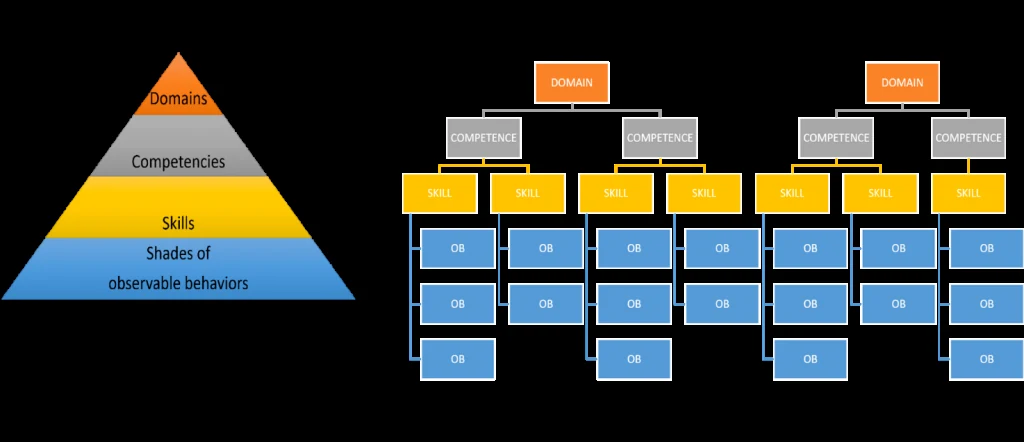
A model that details the whole hierarchy serves two purposes: aligning people with the organization's vision, and providing an organized system to evolve behaviors. Classical training pursues the second with a cognitive approach, explaining the model and the expected behaviors. But behaviors are acted mostly through habits, so the cognitive part must be integrated with practice: immersing people in authentic situations where behaviors are tested and trained. Role play is the ideal strategy, and digital role play the scalable version of it.
Even so, practice alone is not enough. To be effective, a practice tool must embrace the whole hierarchy in a balanced way: it must recognize the behaviors the trainee deploys, grade them in context, and make the character respond realistically.
Grading and shading behaviors
The first decision is how many levels of grading to use; five is the best compromise between specificity and granularity. Beyond the simple grading from better to worse, a skill can branch into different behaviors whose effectiveness depends on the goal: asking open questions is optimal when exploring, asking closed questions is optimal when classifying.
To order behaviors correctly, six criteria contextualize why a behavior is optimal or not in a given moment: the character we are meeting, the type of conversation, the topic, the scope of the measurement, the seniority of the trainee, and the moment in the conversation. This situational approach is the key to success, as it is for leadership styles.
How it works in a digital role play
In early digital role plays, these gradings were encoded in sets of sentences the trainee chose from. Today the trainee speaks freely, and the analysis recognizes which behavior each sentence expresses, at which grade, given the context. Each skill is checked many times along a conversation and a circuit, so the measurement is precise and weighted, and the scenario is designed so that every step calls on specific skills, which is what makes the storytelling a trigger for action.
The review after the conversation closes the loop. The trainee sees, for each thing they said, which behavior it expressed and at what grade in that specific context, and can trace the line from their words up through skills and competencies to domains. We call it reverse engineering of the model: the abstract becomes concrete in the trainee's own sentences. Combined with the character's account of the conversation and with metrics, this loop of experience, feedback, reasoning and re-experience is what evolves behaviors, and with them the skills of leaders and of the whole organization.
Behavior mapping
Which criteria connect a competency model to the design of a scenario? The primary one is effectiveness: a scenario is designed as a situation, defined by type of conversation, topic, character and role of the trainee, and each situation calls for a preferred leadership style, which attracts certain skills and behaviors. Once the skills are identified, the plot is developed so that each passage checks one or more of them, around ten times across the story.
The weighted aggregation of behaviors into skills is decided at design time. The upward aggregation of skills into competencies can be done afterwards, by analyzing the meaning of skills and behaviors and finding which ones contribute to each competency of the client's model. Because skills and behaviors are the most elementary pieces, it is usually straightforward to bring several together to match a competency, by excluding, aggregating and weighting. This is how ready-made scenarios map onto proprietary models, and how scenarios built from a client's own materials are measured against that client's model from the start.
Conclusions
To give a competency model actionable meaning, clarify what each component means and how the components relate. Then connect the model to a form of measurement and development that people recognize as meaningful. The most actionable strategies involve role play, and when a digital role play works on observable behaviors well aggregated in a comprehensive skill map, it fits any competency model upwards. Choose tools that work at that level: it is what makes the model live in everyday behavior rather than on a poster.