
Every culture puts behaviors and values into practice in its own way. The words used, the way disagreement is expressed, the signals of trust or distance: all of these must be understood to have effective business conversations, and all of them change when a behavioral role play crosses a border. Here is how we think about it.
Culture and behavioral training
Anyone in L&D knows the central role of the socio-cultural context in learning, especially for soft skills: the perceptions, feelings and practices of every trainee are filtered by the culture they belong to. A digital role play that aims to improve real-life behavior, by having people converse with a character and evaluating the behaviors they express, is affected on at least three structural levels: the verbal forms in which behaviors are expressed, the way the character reacts to those behaviors, and the character's own identity and manner.
Emic and etic
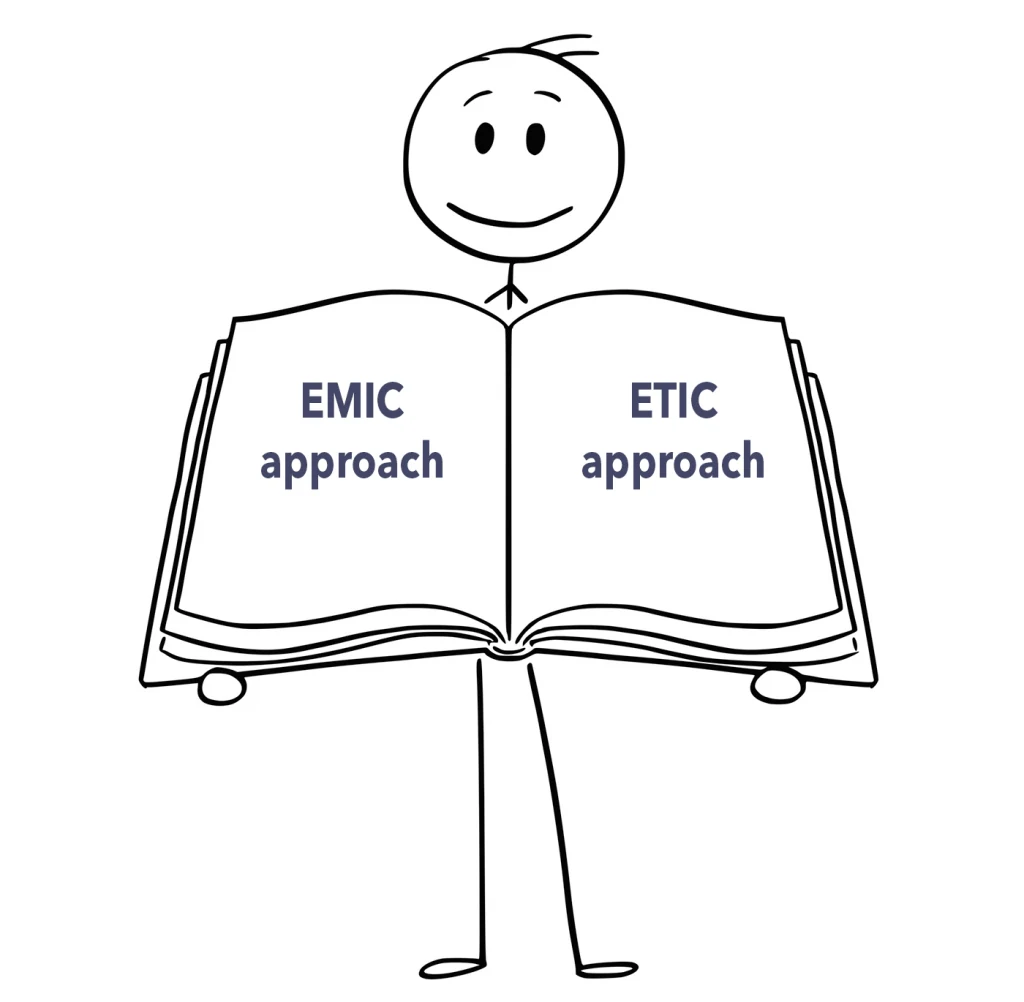
Behavioral sciences describe two approaches to culture. The etic approach takes an outside perspective and looks for categories applicable across cultures. The emic approach takes an inside perspective and describes behavior as a member of that culture would, from within its specific traits.
Both are needed to localize a behavioral role play. In designing content, we start etic: identifying the universal categories that underlie a behavior in every culture. Active listening, engaging people and results orientation are expected of managers everywhere. Then the development follows an emic approach: expressing those behaviors the way the target culture actually expresses them, defining how a person from that culture typically reacts to them, and giving the character an identity, a manner and a way of speaking that are consistent with the local context.
Take a scenario designed for an English-speaking context and bring it to the Middle East. The cross-cultural structure stays: the phases of the conversation, the behaviors and the skills measured. What is realigned is everything that carries culture: the language, the way behaviors are phrased, the character's references, identity and expressiveness. The result is a new scenario, coherent with the new context, training and measuring the same behaviors as the original.
What changes in the words
Social dynamics shape how people relate at work. In some cultures employees find meaning in support from their managers more than from peers, and a leader who gives precise indications and conveys authority has a more positive effect than in contexts where people expect to build networks with colleagues and take part in decisions. Localizing a scenario on managing a team into a Central European country calls for forms that convey openness and participation; the same scenario in another context may call for more direct expressions and a clearer top-down approach. Cultural metaphors matter too: the images that resonate in one society about self-awareness, resilience or balance are not the ones that resonate in another.
What changes in the character
Beyond words, the nuances of how a character shows what they feel vary with culture. In some contexts, openly showing emotion is part of building a trustworthy relationship, and a trainee expects the character to express reactions freely; in others, an understated reaction is the credible one. Even the way a character presents themselves, and what counts as professional, differs from one place to another. A localized character has to react in the register that trainees from that culture recognize as real.
How we localize today
The principle has not changed; the process has. Localization is now a dedicated set of agents in the setup pipeline of a circuit. Starting from the reference scenario, the elements closely tied to the original context are identified: cultural references, idioms, the character's background and interests, the way behaviors are phrased. The agents translate and adapt everything the real-time layer will use during a session, the character's behavior as much as the live coach's hints, with a semantic and cultural adaptation rather than a translation. Where the materials leave a doubt, a local subject-matter expert validates the choices before go-live.
Because this happens before the session, the conversation runs natively in the target language, with the full capability and speed of the models and without any real-time conversion. The quality of the experience in Japanese or Brazilian Portuguese is structurally equivalent to the one in English, across more than thirty languages.
More than localization: adaptation
Sometimes the elements to change go deeper than culture. The original scenario may refer to products, conditions or practices that do not apply locally. This is adaptation, typically requested by multinationals that adopted the method in their headquarters country, with content built around product lines, corporate terminology or regulatory frameworks that differ elsewhere. Adaptation follows the same steps with deeper rework of the plot, while the structural elements stay: the phases, the observable behaviors, the skills. With scenarios built from a client's own materials, adaptation is often simply a matter of feeding the local materials to the same pipeline.
The benefit for global organizations
Global organizations need competency models that are universally acceptable and, at the same time, understood and applied by employees everywhere. Localized scenarios let a company distribute one instrument that trains everyone according to a single, centralized competency model, while each country gets a version built around its own culture. The central model, developed etically, is applied to concrete, local references. Everyone practices the same behaviors; everyone practices them in a conversation that feels like their own.