
Leadership cannot exist without conversations. Communicating with other people is the only way to move them towards a common goal, and a true leader uses conversations to inspire, support, lead and discover. Through empowering conversations, a leader creates a mindset of abundance that enables creative thinking, innovation and continuous improvement.
Leaders need followers
You can be a great cook even if nobody has tasted your dishes, or an excellent guitarist with no audience. Leadership does not work that way. It exists only through recognition by others, which means it exists only through interaction: a leader has to communicate, and let their words move people in a shared direction.
In a complex, hyperconnected world, communicating is not enough. A leader cannot broadcast a vision in impersonal, one-way messages and expect lasting change. Involving people requires a more democratic, empathetic and engaging form of interaction: the face-to-face conversation.
Conversational leadership is not an option
Handling a conversation well is not a nice-to-have for a leader. The organization asks for it. The team asks for it, explicitly if the leader is lucky, between the lines in most cases. Leadership is not a medal you pin on your own chest: it is recognized by a community, and it is effective only when it spreads a positive energy capable of generating new leaders in turn.
The educator Carolyn Baldwin describes conversational leadership as a core process for cultivating the collective intelligence needed to create business and social value. As a core process, it sits at the center of any empowerment strategy, and its aim is not to place the leader at the top of a pyramid but to involve the whole group in a self-sustaining process.
The four areas of conversational empowerment
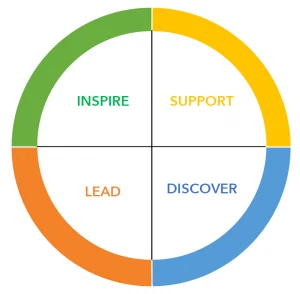
Like other authentic leadership models, conversational leadership revolves around self-awareness, transparency, ethics and balanced relationships. On that basis, the conversations a leader proposes can move in four directions:
- Inspire. Motivation and collaboration come from a shared vision. Leading an inspiring conversation requires the courage to risk failure and the credibility not to.
- Support. Helping people find their own way to grow. This is the territory of the coaching style: developing people for the future by connecting individual goals with the organization's long-term success.
- Lead. Giving clear direction and expecting it to be followed. It works only if the leader appears clear and intellectually honest, because nobody complies with directives they do not understand from a person they do not trust.
- Discover. We grow through confrontation with ideas different from ours. A good leader knows that there is a treasure in the experiences they have not had and the points of view they have not considered, so they listen and learn.
Think of the four areas as the points of a compass. Every conversation moves towards one of them, depending on the leadership style, the counterpart's needs and the goal. If you asked a team member to complete the sentence "I would really like my boss to be more...", the answer would fall into one of these four.
Types of conversations
Each area contains different conversations. Inspire covers building trust in the team or motivating people towards continuous improvement, always within the company's culture. Support covers easing change, resolving conflicts, nudging towards better choices, removing the obstacles that stop people from doing their job. Discover covers onboarding a new colleague, exploring strategic options together, aligning someone with the organization's values. Lead covers negotiating and delegating: representing one's interests fairly and handling objections in the first case, assigning a task with clear directions and complete information in the second.
Why teams need conversational leaders
Imagine a team whose leader cannot have these conversations. Without inspiring conversations, the team stays a collection of individuals with no shared sense of purpose. Without supportive ones, daily work gets harder and the workplace worse. Without discovery, decisions are made on incomplete pictures. Without leading conversations, the right message never arrives and things simply do not happen.
Neuroscience offers a reason for the power of conversations. Emotional and cognitive processes are deeply linked: concepts are learned faster when an emotion is associated with them, repetition automates emotional learning, and emotions are contagious. A state of empathy with the counterpart accelerates the message, because cognitive learning is accompanied by emotional learning. The more these conversations recur, the longer their effect lasts.
A long-term impact
Richard Boyatzis studied the moments in which people felt an "interpersonal synchronicity" with a significant leader. Recalling those moments activated neural circuits years later: an empowering conversation is remembered as a life-changing moment, and its memory alone produces energy. Many of the people in that study later became executives themselves.
The conversational leader triggers a chain reaction. The counterpart learns from an effective conversation, adopts its values and passes them on. Personal development spreads through the team and becomes a model others follow.
The bad news, and the good
None of this can be improvised. Engaging and motivating conversations are hard and require confidence. That is why we call them critical: they sit outside our comfort zone, and without enough practice we know our objective but lose our arguments the moment we start talking.
The good news is that there is a clear pattern to turn critical conversations into empowering ones, and practice is the key. The more we train, the more confident we become. Conversational leadership cannot be episodic: it has to be seeded and nurtured across the organization until having these conversations becomes a shared quality of the team, and with it openness, creative thinking and innovation.
That is what a training circuit of conversational role plays is for. Not a course about leadership, but repeated practice on the conversations themselves, with characters who react like real team members and feedback that shows what each choice produced. One conversation at a time.